
You can now find me here.
Sunday, July 10, 2011

Wednesday, December 1, 2010
RESURRECTION.

It has been two years (!) since my last post, but I have decided to start fresh. This time, I am going to focus on three fields that are closest to my heart: arts, education and arts education.
My pet project is the development of new genre of dramatic literature: Young Adult Theatre (YAT). You can follow that more closely on my other blog, linked here.
Friday, August 8, 2008

Tuesday, July 22, 2008

Sunday, July 20, 2008
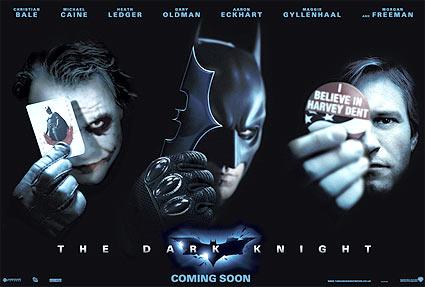
THE DARK KNIGHT (2008)
Film opinion
Directed by Christopher Nolan
Written by Christopher Nolan and Jonathan Nolan
Story by Christopher Nolan and David S. Goyer
Characters created by Bob Kane
With Christian Bale, Heath Ledger, Aaron Eckhart, Michael Caine, Gary Oldman, Maggie Gyllenhaal, and Morgan Freeman
Exceeded my lofty expectations by twisting the dramatic tension tighter and tighter. Christian Bale is great, as usual, as both Bruce Wayne and Batman. Heath Ledger's Joker is as terrifying, disturbing, hilarious and mesmerizing as everyone says. I was pleasantly surprised at how well Harvey Dent was crafted, and Aaron Eckhart deserves credit for imbuing him with charisma, humanity and tragedy. Stunning set pieces highlight what is ultimately a character-driven crime drama that is closer to The Departed and Heat than X-Men and Iron Man. Epic in scale, I didn't want the film to end even is it clocked in at two and a half hours. Very dark. Left me wondering where the story will go from here.
GRADE: A
GYPSY
Theater opinion
Music by Jule Styne
Lyrics by Stephen Sondheim
Book by Arthur Laurents
Suggested by the memoirs of Gypsy Rose Lee
Directed by Arthur Laurents
Original choreography by Jerome Robbins, recreated by Bonnie Walker
Music Directed by Vaccariello
With Patti LuPone, Laura Benanti, Boyd Gaines, Leigh Ann Larkin, Tony Yazbeck, Alison Fraser, Lenora Nemetz, Marilyn Caskey
At the St. James Theatre, New York City.
A funny thing happened on the way to the masterpiece. With the latest revival of Gypsy taking three out of the four acting awards at 2008 Tony Awards, including a Best Actress win for star Patti LuPone, I was prepared to take in what is widely hailed as the definitive production of what some consider the best musical of all-time. Right upfront, I will say that I am a big Patti LuPone fan and I rank Gypsy among my Top Ten favorite musicals. Furthermore, I saw the much-criticized 2003 revival starring Bernadette Peters and directed by Sam Mendes, and I loved it. For better or for worse, I had difficulty not comparing this current production to that recent revival, but having read many reviews, it seems that most professional critics couldn’t keep from making comparisons either. That being said, I disagreed with most of the critics in 2003, and I disagree with most of the critics in 2008.
In short, I preferred Bernadette Peters to Patti LuPone, I thought the supporting actors were better in the 2003 company than the current one, and I felt that Sam Mendes did a far better job of directing than Arthur Laurents did.
To be clear, Patti LuPone was terrific, a fine Mama Rose, doing the belting and chewing the scenery as everyone expected her to do. But that’s the thing: Ms. LuPone played Mama Rose exactly as expected, with few surprises save a handful of strong, different but ultimately distracting choices when singing her songs. I missed the coyness and vulnerability of Ms. Peters’ Mama. For Ms. LuPone, Mama’s breakdown happens in “Rose’s Turn,” the tour de force closing number, but the break doesn’t feel earned; instead, it feels that Mama breaks down at that point because that’s where “Rose’s Turn” arrives in the script. In 2003, Mama Rose’s true break happened earlier in the show, when she volunteers her daughter Louise to take the place of a stripper in the burlesque show. I remember the audible gasp in the audience when Ms. Peters did that, her face open to the audience, the others (especially Louise) arranged beautifully to react to this mother essentially prostituting her daughter. Louise somehow rises from this debasing low-point to achieve stardom, on her own terms, and this is what begins Mama Rose’s downward spiral, so that “Rose’s Turn” is the rock-bottom of a slow, agonizing descent of recognizing that she was wrong all along. And Ms. Peters broke your heart when she sang it because you felt that yes, Rose could have been somebody -- maybe -- had she had someone like her to encourage and nurture her. In 2008, Mama’s self pity feels unearned, though you do feel bad for her because her daughters are so nasty to her.
Laura Benanti won a Tony for playing Louise in this production. Tammy Blanchard did not win a Tony for playing Louise in the 2003 production. Those facts should be switched around. Ms. Benanti does have a few touching moments, most notably in “Little Lamb,” a poignant song that communicates everything the audience needs to know about Louise’s childhood. But her transformation from fragile child to queen of burlesque is not believable, mainly because Ms. Benanti plays awkward as stilted and buffoonish. The story requires Rose to transform into Gypsy Rose Lee over the course of a series of “Let Me Entertain You” numbers, a fault in the book, in my opinion. Tammy Blanchard managed to pull it off in 2003, though, because her Louise when from gawky to graceful, innocent to risque. You felt that she could break, emotionally and physically, at any moment. In 2008, Laura Benanti’s Louise goes from dorky to bitchy, sheepish to angry. By the time Benanti’s Louise screams at Mama near the end of the show, I felt only that I was watching a Tony winner “play angry” in a way that they could see way up in the balcony.
I had other problems with this production. Boyd Gaines also won a Tony for his Herbie, but he didn’t much register for me. The Junes, Dainty (Leigh Ann Larkin) and Baby (Sami Gayle), gave downright poor performances. Baby June must have been directed to give grotesque smiles, and maybe they looked cute from way up there, but from up front they were disturbing. And grown-up June just pissed me off with her cruelty to Louise, her strange voice modulations, and unprofessional breaking character. Tulsa (Tony Yazbek) danced well, but as my esteemed colleague [name removed to protect his anonymity] noted, he looked way too old and “he played Tulsa like he was retarded.” Also, I felt that I had seen Tulsa’s dance before because, well, I had, in every single professional production of Gypsy. “Original choreography by Jerome Robbins” is a phrase I have come to loathe, though I suppose one can argue that choreography is as much a part of constructing a musical story as the book, music and lyrics are. But for the love of God, Jerome Robbins Estate, please relent and let some other choreographer take a crack at interpreting the works that the man directed and choreographed!
"You Gotta Have a Gimmick" is a can't-miss number, and it didn't miss in this production. In fact, Tessie Tura (Alison Fraser), Mazeppa (Lenora Nemetz), and Electra (Marilyn Caskey) were, besides Patti LuPone, the best part of the show. Ms. Fraser did go through about ten accents, from Bronx to Irish to Grizabella the Slut Cat, but I didn't care too much. Ms. Caskey's Electra was my favorite because she played the character as if she'd been shocked by her electric suit more than once. The way she stiffly moved and stared at the audience, ozone-eyed, was hilarious. The set was alright. I liked how everything looked very, very cheap, including the curtains and costumes. The large orchestra was placed on the stage behind a scrim, perhaps because this is a tradition for productions transferred from Encores at City Center. It didn’t work, especially when Mama makes multiple references to the conductor in front of the stage, directing her instructions instead to the front row of the house.
So, I was very disappointed, but I can’t say that Gypsy was a bad production. The show, especially that terrific score, is just to strong to fail that easily. It is indeed worth seeing for Patti LuPone’s performance. She doesn’t let you down when she belts out “Everything’s Coming Up Roses” and “Rose’s Turn.” But Mr. Laurents needs to get back to work and freshen up these performances, or perhaps let an assistant director take a crack at it. Mr. Laurents will soon be directing a long-overdue revival of West Side Story, "with original choreography by Jerome Robbins." (Hear my plea, Jerome Robbins Estate!) One twist is that Mr. Laurents wants the Sharks and their girls to speak and sing in “some” Spanish. (I would love to hear Mr. Laurents talking Stephen Sondheim into revisiting his lyrics in Spanish translation.) I hope that Mr. Laurents devotes himself to updating that script and decides to let someone else tackle directing responsibilities. His fine writing work deserves a strong director to truly make it come alive.
GRADE: C
Monday, July 14, 2008
IN THE HEIGHTS
Theater opinion
Music and Lyrics by Lin-Manuel Miranda
Book by Quiara Alegria Hudes
Conceived by Lin-Manuel Miranda
Directed by Thomas Kail
Choreographed by Andy Blankenbuehler
Music Directed by Alex Lacamoire
With Lin-Manuel Miranda, Andrea Burns, Robin De Jesus, Carlos Gomez, Mindy Gonzalez, Christopher Jackson, Priscilla Lopez, Olga Merediz, Karen Olivo, Seth Stewart
At the Richard Rodgers Theatre, New York City.
First of all, it was truly stunning and inspiring to see a Broadway stage filled with Latino performers, and to hear Latin and Caribbean beats pulsating from the orchestra pit of the Richard Rodgers Theatre. The crowd was the most racially diverse one I had seen since The Color Purple in 2006, and it was heartwarming to hear Spanish on stage and in the audience. In the Heights is a milestone for Latino artists and stories in American theater. Though Latin beats have been a mainstay in musicals since West Side Story in 1957, this is the first one created by Latino artists to find commercial and critical success.
In The Heights defies stereotypes of what a Broadway show looks and sounds like, but it is, in many ways, a rather conventional musical. The story goes exactly where you think it will go. Will the protagonist, Usnavi, leave Washington Heights? (For a hint, note that this show is not titled Out of the Heights.) Its characters follow tried-and-true character arcs, it gives its supporting players plenty of crowd-pleasing moments, and it leaves audience members feeling good about their trip to the barrio … even if most will still avoid actually going there. The assertion that gentrification (e.g. whitification) of neighborhoods is bad has become cliche, though the show glosses over the fact that the predominantly Latino population of Washington Heights is just one incarnation of a constantly evolving neighborhood. (I would like to see a musical about the tensions that arise when Latinos move, as one character in this show does, into predominantly black neighborhoods in the Bronx, neighborhoods that were once predominantly white.) That being said, my primary complaint about the show is the frequency of songs that feature characters stopping the action to sing about what they’re thinking. However, though the story structure lacks originality, it compensates for it with high energy and terrific music that had me grooving in my seat. Though I can be critical in hindsight, I will tell you that I greatly enjoyed the show as I was watching it.
Of course, the heart and soul of In The Heights is its creator, composer, lyricist and star, Lin-Manuel Miranda. He has fantastic charisma and comic timing. To see him take in a standing ovation at curtain call was to see a man still in awe of the fact that his labor of love has been so warmly embraced by the Broadway community. His performance is the anchor of the play. In fact, it is difficult to imagine what watching the show would be like without Mr. Miranda playing the lead. Woe to the understudy who has to face an audience expecting to see the boy genius. In The Heights had been performing to half-full houses before Mr. Miranda accepted the Tony Award for Best Score with a charming rap. The night I saw it, the house was full and everyone was having a great time. It ought to have a good, long run as long as Mr. Miranda stays in the show. Judging by how much fun he was clearly having, he will likely stay with his baby for a long, long time.
GRADE: B
MY WINNIPEG (2007)
Film Opinion
Directed by Guy Maddin
Written by Guy Maddin and George Toles
With Darcy Fehr, Ann Savage, Amy Stewart, Brendan Cade, Wesley Cade
Probably the most visually intriguing and narratively confounding "documentary" I have ever seen. One is never sure just how much of Guy Maddin's history of Winnipeg is actually true but, man, is it fun to watch. Laugh out loud funny at times, poignant and sad at others, MY WINNIPEG had me mulling it over for days afterwards. Don't be turned off by the seemingly heavy poetic voice-over early in the film; it takes off and soars eventually.
GRADE: A-
WALL-E
Film Opinion
Directed by Andrew Stanton
Written by Andrew Stanton and Pete Docter
Vocal Talent: Ben Burtt, Elissa Knight, Jeff Garlin, Fred Willard, John Ratzenberger, Kathy Najimy, Sigourney Weaver
This is Pixar's best so far. The first forty-minutes are truly sublime despite (or maybe because of) almost zero dialogue. Scathing satire and beautiful imagery are both in service to a central love story that reminded me of Charlie Chaplin films. I will see this again soon.
GRADE: A

2.0
After a long hiatus, Bub's Studio will be returning with a vengeance. Over the next few days, expect fresh opinions on theater, film and books. As long as I have this thing, I should very well use it.
Friday, June 20, 2008
Tuesday, March 11, 2008
Saturday, January 12, 2008
THERE WILL BE BLOOD

Film Opinion
Written and Directed by Paul Thomas Anderson
Adapted from OIL! by Upton Sinclair
With Daniel Day-Lewis, Paul Dano, Dillon Freasier, Ciaran Hinds, Kevin J. O'Connor
Paul Thomas Anderson's latest film, THERE WILL BE BLOOD, is a powerful, haunting film driven by the incomparable Daniel Day-Lewis in the lead role. Proving that the best book-to-film adaptations draw on weak material, Anderson mined dramatic gold from Upton Sinclair's anti-capitalism novel, Oil!. Much of the film story reminded me of a John Steinbeck with Eugene O'Neill ending. The director's canvas is large, and he fills it with gorgeous imagery: a flaming oil tower, a muddied father holding his injured son, endless brown fields and then, suddenly, the sea. And, most surprisingly, vast expanses of blackness pierced by a fire-lit demon's head, or the reflections of a few bits of silver in the rock. So assured is Anderson with his imagery that there is only one line of dialogue -- "There she is. There she is." -- in the first twenty minutes of the film.
With all of that said, the film's soul is Daniel Day-Lewis. The actor delivers one of the greatest film performances I have ever seen in capturing the ambitious, ruthless, yet strangely loving entrepreneur, Daniel Plainview. Much has been written about his performance by critics elsewhere: his kabuki-inspired facial expressions, his deceptively reassuring voice, his ability to shift from joy to rage in the blink of an eye. For me, Plainview's pragmatic "rebirth" in Eli Sunday's church is the pinnacle of his mesmerizing turn. In that scene, Day-Lewis is alternately annoyed, embarrassed, enraged, ashamed and vengeful, and he allows all those emotions to pass across his face, indeed throughout his entire body, almost simultaneously. He is the true master of cinematic acting, but I did fault his performance near the end of the film. More on that in a bit.
Prior to this film, I was underwhelmed by Paul Thomas Anderson's work as a director and writer. In fact, I thought he was very overrated. Boogie Nights bored me. Magnolia irritated me because it rang false. I did enjoy Punch-Drunk Love, however. With this record, I was skeptical of the rave reviews for There Will Be Blood, but encouraged by those who said it was a departure for the film-maker.
At almost two and a half hours, Blood does drag at moments. The intriguing central conflict, oil man vs. prophet, practically disappears in the third quarter of the film. Perhaps the true conflict is man vs. self? The ending of the film, which takes place twenty years after the majority of the action, is bizarre and out of sync with the rest of the film. Sadly, after two-plus hours of following Daniel Plainview, I was suddenly reminded that I was watching an actor, albeit it a great one. I fault Anderson for this mostly, because he lets the story get out of hand. Plainview and Sunday mostly played subtle games of one-upmanship, but they go broad at the end. The brilliance of the first two hours of the film was that we could see the road that Plainview's ambition was taking him; actually seeing that end seemed unnecessary, and in fact detracted from the overall experience.
That being said, There Will Be Blood is one of the best films of 2007, and probably in the last few years. Though it is only playing in a few theaters, all cinemaphiles should seek it out. It must be seen on the big screen to be fully appreciated.
GRADE: A-
Tuesday, December 25, 2007
Friday, December 21, 2007
ATTEND THE TALE ...

SWEENEY TODD: THE DEMON BARBER OF FLEET STREET
Directed by Tim Burton
Music and Lyrics by Stephen Sondheim
Adapted for the Screen by John Logan
WITH: Johnny Depp, Helena Bonham Carter, Alan Rickman, Timothy Spall, Sasha Baron Cohen, Ed Sanders, Jamie Campbell Bower, Jayne Wisener, Laura Michelle Kelly
Tim Burton's adaption of one of my all-time favorite musicals is excellent. Johnny Depp's stirring performance is the primary reason, but credit also goes to Helena Bonham Carter as Mrs. Lovett and little Ed Sanders as Tobias. The gorgeous art direction, inspired by the Hammer horror factory, and new orchestrations by Jonathan Tunick, nearly steal the show. The film is tense, darkly hilarious, and paced well thanks to some song cuts that initially pissed me off. There must have been extraordinary creative synergy on this project; everyone is on top of their game. For fans of the musical that are pissy about non-operatic singers playing the roles, leave your preconceptions at the door and enjoy this film for what it is: a Grand Guignol masterpiece. Yes, there is BLOOD all over the place, but it has never looked more beautiful. Why is it so good? Johnny Depp dominates the film as the vengeful Sweeney, and his raw but expressive singing voice captures the character well. Helena Bonham Carter's voice leaves something to be desired, and there were times when she downplayed a little too much for my taste, but her "By the Sea" is absolutely brilliant, and her final scenes are gut-wrenching. Alan Rickman is fine as the morally warped Judge Turpin. I was angry that his "Mea Culpa" was cut, but I was delighted with a new scene written for the film that introduced the judge's collection of international erotica. Sasha Baron Cohen is funny and perfectly sleazy as Pirelli, but I must have been the only person in the audience who laughed out loud at his outrageously stuffed pants. Finally, Ed Sanders is moving as Tobias, especially when he sings "Not While I'm Around;" his voice, probably one of the strongest overall, perfectly captures the boy's hopefulness, courage, and fateful naivete.
Besides the performances, the look of the film is absolutely gorgeous, and I applaud director Tim Burton, production designer Dante Feretti, and cinematographer Dariusz Wolski. Inspired by the films of the Hammer horror factory of the 1950s, 60s, and 70s -- I love those films! -- Sweeney's London is perpetually dreary. It is black, white, and shades of gray, a color palette which makes the blood, the streams and streams of bright red blood, all the more vivid. Much has been made of the amount of blood in Sweeney Todd, but it is entirely appropriate for the Grand Guignol style of the work. Stephen Sondheim himself loves the blood, and so do I.
There are some wee complaints. Jamie Campbell Bower and Jayne Wisener barely register as Anthony and Johanna, but that was to be expected with their big duet, "Kiss Me," cut from the film. Ultimately, though, my sheer delight at watching the film made me forget about those tiny glitches. I was very skeptical that Tim Burton could pull off a good adaptation of Sweeney Todd, but I am very happy to say that I was wrong to doubt him. But let's not forget that Stephen Sondheim is the true genius behind everything. It his music, his lyrics, and his idiosyncratic view of the world that forged this masterpiece.
GRADE: A
Saturday, December 8, 2007
THE GOLDEN COMPASS
 FILM OPINION
Written and Directed by Chris Weitz
Based on the Novel by Philip Pullman
CAST: Nicole Kidman, Daniel Craig, Sam Elliott, Ian McKellen (voice), and Dakota Blue Richards
With the historic success of the Harry Potter books and movies, not to mention the Lord of the Rings and Chronicles of Narnia franchises, Hollywood has predictably saturated the market with film adaptations of popular fantasy novels. While the LOTR trilogy was absolutely stunning and some have been quite entertaining (Harry Potter), most adaptations have been either serviceable (Narnia) or disappointing (Eragon and Series of Unfortunate Events foremost among them) have been disappointing. Coming soon are Holly Black's Spiderwick Chronicles and Cornelia Funke's Inkheart, but kicking off the latest wave is The Golden Compass of Philip Pullman's Dark Materials trilogy. Though such a film would seem to have a built-in audience with fans of the book, blockbuster status can only be attained by seducing the "casual film-goer" into spending ten bucks to see it. How do you do that? Stunning visuals in the trailer, and name stars.
The Golden Compass certainly has both. Some of the visuals are absolutely beautiful, particularly the aerial shots of the College and the alternate version of London. As for stars, they don't come any bigger than Nicole Kidman and Daniel Craig. The Golden Compass fares better than your typical fantasy in that it boasts a compelling protagonist, the feisty and resourceful Lyra (Dakota Blue Roberts). It also has the neat conceit of animal "daemons," physical manifestations of human souls. An indicator of the level of talent that the film drew can be found in the voice talents: Ian McKellen, Kristin Scott Thomas, Kathy Bates, and Freddie Highmore. That being said, the film understandably tries to do too much. While it has some very exciting moments (particularly among the bears), it peters out at the end and intentionally leaves the story unresolved. What goes wrong? In short, too much plot involving too many characters in too short a time. It is difficult to care for any of the people involved; in fact, I most identified with Iorek Byrnison, the war bear.
Of course, The Golden Compass is stirring up all sorts of controversy because of author Philip Pullman's avowed atheism. Indeed, the menacing, all-powerful institution is called The Church in the novels, softened as the Magisterium in the film. The heroes are fighting for that greatest of all threats to fundamentalism, FREE WILL, and the villains are trying to brainwash the children into non-questioning believers. While The Golden Compass is not a great one, I can't help but encourage people to see any film that seeks to undermine such controlling paradigms.
GRADE: C
Monday, December 3, 2007
Thursday, November 29, 2007
THINK PINK RADIO
I was invited to write weekly posts at the blog for Think Pink Radio based out of WLUW 88.7 FM in Chicago. The show itself is independent, all-music, and devoted to queer music artists. The blog aims to become a hub for queer arts, literature, events and anything else we think will interest people around the country.
My own contributions to the Think Pink Radio blog will focus primarily on film, theater and Pacific Northwest interests. However, I am a man of many interests and much curiosity. To quote Miss Dickinson, "I dwell in possibility."
My own blog will continue to house my more verbose opinions. To check out my November 29 post on the new Todd Haynes film, I'm Not There, click below. Begin to Think Pink.
THINK PINK RADIO (WLUW 88.7 FM - Chicago)
THE ABSOLUTELY TRUE DIARY OF A PART-TIME INDIAN
by Sherman Alexie
Illustrations by Ellen Forney
BOOK OPINION
Any book that can make me laugh out loud and cry unabashedly deserves my highest praise. In The Absolutely True Diary of a Part-Time Indian, author Sherman Alexie mines his own adolescence to tell the story of Junior, aka Arnold Spirit. Junior has several decks stacked against him. He was born "with water on the brain," a condition that required a highly risky operation to treat and left him with speech issues and seizures. On top of that, Arnold is highly intelligent and sensitive, two traits that drop him squarely on the bottom of the pecking order on "the rez," the Spokane Indian Reservation. Dangerously close to despair, Arnold makes a desperate and impulsive decision to enroll at Reardon High School, an all-white high school in a well-to-do suburb of Spokane. The majority of the story is about how Arnold struggles to fit into the white and Indian worlds when neither will fully embrace him. Junior, blessed with intellectual gifts and a surprisingly consistent jump-shot, carves a niche for himself at the new school by forging key friendships. At the same time, he mourns the loss of his best friend Rowdy back on the rez, who sees Junior's defection as the ultimate sell-out. When Junior's first basketball game pits his Reardon team versus his old high school, a game played on the rez, it is almost too much for him to bear.
Awful things happen in the book, and it would be downright depressing if it weren't so damn funny at the same time. While Junior is certainly a bright, articulate individual, he is still a fourteen year-old kid who loves basketball, reading books, drawing comics, and masturbating. Ellen Forney, a Seattle-based comic artist, perfectly captures Junior's humor and world-view with her hilarious renderings. Most importantly, however, Sherman Alexie epitomizes the notion of laughing in order to keep from crying. He uses humor to illustrate the sadness, hopelessness, and sheer poverty of the people in Junior's world on the rez. At the same time, he allows Junior to cut loose in his frustration and rage, and the boy's anger at being rejected for simply bettering himself, saving himself, is palpable. The central relationship is between Junior and his best friend Rowdy. Their love-hate relationship is symbolic of many Big Ideas, but their identities are always authentic and potent. They are flawed individuals, but you care deeply for both of them, and want these two confused, hormonal, but ultimately loving ninth grade boys to just get back to the way they were. That their struggle with each other is so honest and compelling is a testament to Alexie's skill.
Sherman Alexie was awarded the National Book Award in the Young Adult Fiction category for The Absolutely True Diary of a Part-Time Indian. It represents the best of YAF: powerful, uncompromising, authentic stories that deal with real conflicts and life-changing events. In the end, these heroes persevere, even if they are gawky, bespectacled, horny teenagers confronting an identity crisis at a ridiculously young age.
GRADE: A-
Sunday, October 28, 2007

Subscribe to:
Posts (Atom)